
Corrugated board is widely used in packaging due to its strength, versatility, and protective qualities. To ensure its effectiveness, manufacturers often perform the flat crush test to evaluate its durability. This test measures the resistance of corrugated board to crushing forces, which is crucial for assessing the material’s ability to withstand pressure during handling, stacking, and transportation.
The flat crush test specifically focuses on the collapse resistance of the fluted structure of the board, which is vital for the performance of corrugated packaging. In this article, we will explore the ISO 3035 standard, the testing procedure, and the significance of the test, along with the role of the edge crush tester in providing reliable results.
What is the Flat Crush Test for Corrugated Board?
The flat crush test for corrugated board is designed to determine the material’s resistance to crushing forces applied perpendicular to its surface. The test involves subjecting a test piece of corrugated fibreboard to an increasing force until the fluting, or the wavy structure between the layers of the board, collapses. The maximum force sustained by the test piece before collapse is measured, providing valuable data on the board’s compressive strength.
This test is essential for evaluating the structural integrity of the board, which directly impacts the packaging’s ability to protect the contents during shipping and handling. It is especially important for single-faced and single-wall corrugated boards used in packaging applications where resistance to pressure is a key requirement.
ISO 3035: Standard for Flat Crush Testing
The ISO 3035 standard outlines the procedure for performing the flat crush test on corrugated board. According to this standard, the test is conducted by applying a compression force to the test piece using two flat and parallel platens. The rate at which the platens approach each other is precisely controlled at 12.5 mm/min ± 0.25 mm/min, ensuring consistency in test results.
The ISO 3035 standard is applicable to single-faced oraz single-wall corrugated fibreboard, but not to double-wall or microflute corrugated boards, as these materials do not have a clearly defined end-point during the test. For each test, at least 10 test pieces should be tested, and the maximum force sustained by the test piece before the collapse of the fluting is recorded.
Procedure for Performing the Flat Crush Test
The flat crush test is a straightforward procedure, but precision is essential to ensure accurate results. The following steps outline the testing process:
- Sample Preparation:
- Condition the test pieces in a standard atmosphere before testing to ensure consistent results.
- Ensure that the test pieces are cut correctly, and the flutes are perpendicular to the platens when placed in the tester.
- Test Setup:
- Place the test piece centrally on the lower platen of the edge crush tester.
- Set the platen speed at the prescribed rate of 12.5 mm/min ± 0.25 mm/min.
- Compression:
- Apply pressure gradually until the fluting collapses.
- Record the maximum force sustained by the test piece before collapse to the nearest 10 N.
- Result Analysis:
- If the flutes lean sideways, the test may be invalid, and the sample should be tested again.
- Test a sufficient number of samples to ensure at least 10 valid results are obtained.
- Reporting:
- Report the average force from the valid test results.
Why is the Flat Crush Test Important?
The flat crush test provides a measure of the crush resistance of corrugated board, which is critical for packaging performance. It helps manufacturers ensure that their products can withstand the compressive forces they will encounter during transportation and storage. This test is especially important for packaging that will be stacked, where the weight of packages on top can cause deformation and damage if the corrugated board is not strong enough.
Oprócz flat crush testing, it is often recommended to perform edge crush tests and other mechanical tests to get a complete understanding of the board’s strength and durability.
The Role of the Edge Crush Tester
The edge crush tester is a specialized tool used to measure the edge crush resistance of corrugated board. It applies a force to the edge of the corrugated board, providing insights into the material’s ability to withstand compression forces in vertical stacking situations. The edge crush test oraz flat crush test are often conducted together to ensure the overall strength and durability of the board.
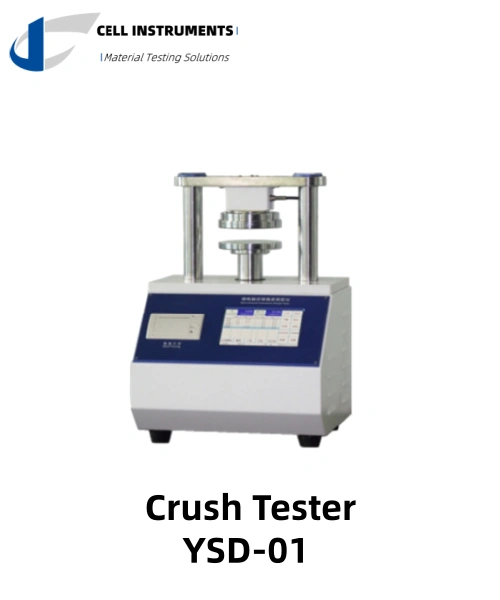
When performing the flat crush test, using a high-quality edge crush tester, such as the Cell Instruments Tester zgniatania YSD-01, is essential for accurate and reliable results. The YSD-01 is designed to deliver precise force measurements, ensuring that the corrugated board is tested according to industry standards and can meet the required strength specifications.
Conclusion
The flat crush test for corrugated board is a critical assessment used in the packaging industry to evaluate the compressive strength of the material. By following ISO 3035 standards and using accurate testing equipment such as the edge crush tester, manufacturers can ensure that their packaging will withstand the pressures encountered during storage and transportation.
For a comprehensive evaluation of packaging strength, it is recommended to use tools like the Tester zgniatania Cell Instruments YSD-01 to conduct flat crush tests, edge crush tests, and other related assessments. This will help ensure that your corrugated board meets the necessary standards for durability and protection.
 PL
PL  EN
EN  AR
AR  BG
BG  CS
CS  DA
DA  DE
DE  EL
EL  ES
ES  ET
ET  FI
FI  FR
FR  HU
HU  ID
ID  IT
IT  JA
JA  KO
KO  LT
LT  LV
LV  NB
NB  NL
NL  PT
PT  RO
RO  RU
RU  SK
SK  SL
SL  SV
SV  TR
TR  UK
UK